
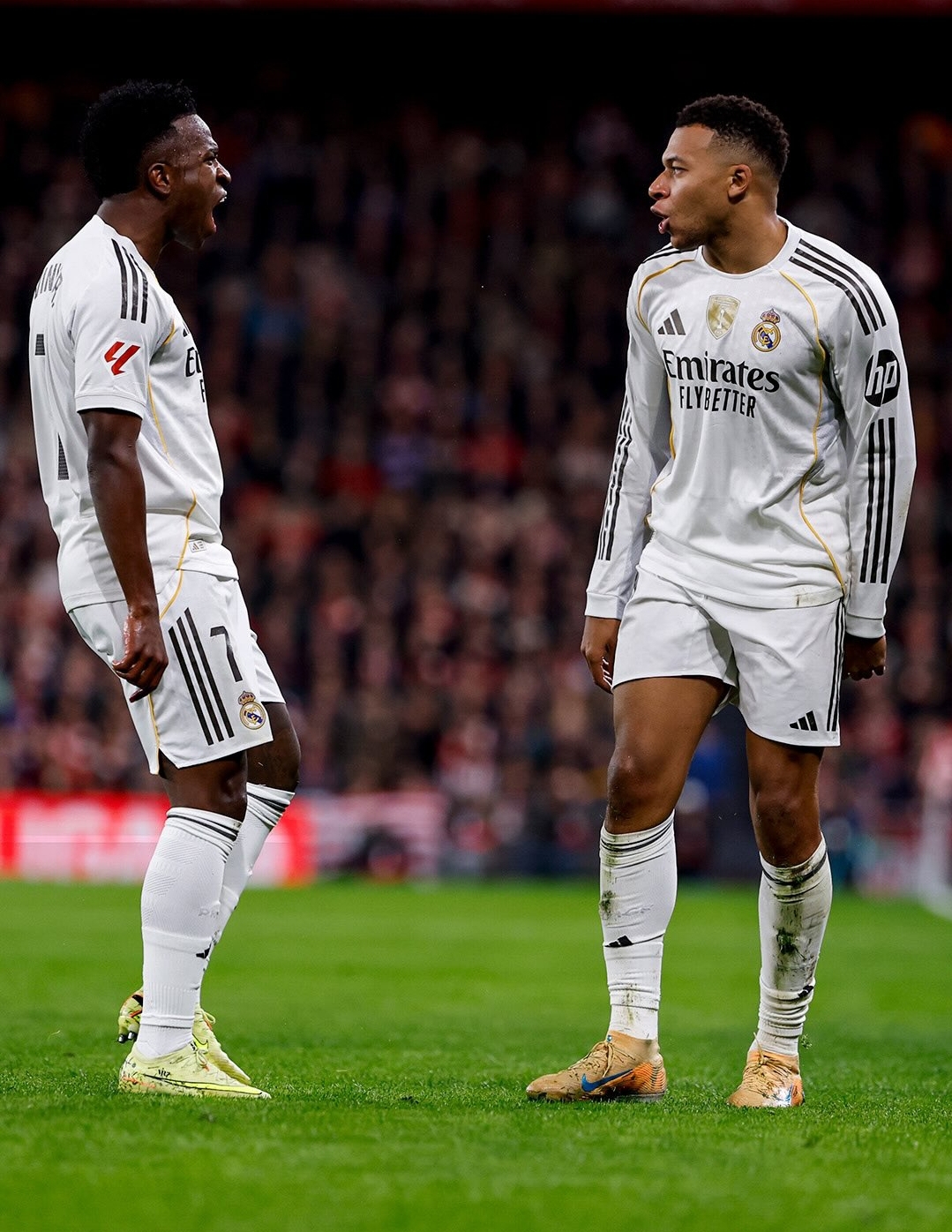
Recent reports across European media suggest that Mbappé’s integration into the squad hasn’t been entirely smooth. Whispers of dressing room discomfort, claims of isolation, and suggestions that some teammates are struggling with his presence have begun to surface. While none of this has been officially confirmed by the club, the noise is getting louder—and in Madrid, noise rarely stays meaningless for long.
What’s making the story even more intriguing is what’s happening on the pitch without him. Real Madrid have reportedly won six matches in Mbappé’s absence, a stat that—fairly or unfairly—has fueled the narrative that the team sometimes looks more fluid without its biggest star. It’s a dangerous comparison, but in football, results always shape perception.
At the heart of the issue is balance. Mbappé arrived not just as a world-class forward, but as a global brand—arguably the face of modern football. That kind of aura can inspire a team, but it can also disrupt hierarchy. In a squad already packed with elite talent, including Vinícius Júnior and Jude Bellingham, questions naturally arise: who leads, who sacrifices, and who adapts?
Reports now suggest that some players are leaning toward Vinícius Júnior as the focal point of the team—both stylistically and emotionally. The Brazilian’s connection with the club, his work rate, and his influence in big moments have earned him strong backing within the squad. Adding another layer to this dynamic, club legend and coach Álvaro Arbeloa is also believed to favor a system that maximizes Vinícius’ strengths, further hinting at subtle divides in footballing philosophy within the club.
Some reports suggest that certain players feel Mbappé’s style of play leans more individual than collective. Others point to moments off the pitch—like his controversial trip during injury recovery—as signs of disconnect. Whether fair or exaggerated, these perceptions can shape dressing room dynamics quickly, especially in a club where expectations are ruthless and immediate success is the standard.
But zoom out, and the situation looks less like a single-player problem and more like a team in transition. Real Madrid are navigating a delicate shift: blending established stars with new superstars, redefining roles, and managing egos at the highest level. That process is rarely smooth—even for the most successful clubs in history.
It’s also worth noting that tension in elite squads is not unusual. Competitive environments breed friction. The difference at Madrid is visibility—every disagreement becomes a headline, every rumor a storyline. In reality, what’s being framed as a “Mbappé problem” may simply be the growing pains of a team trying to find its identity.
For Mbappé, the challenge is clear: adapt without dimming his brilliance. For Madrid, it’s about building a system that doesn’t just accommodate stars, but unites them.
Because at the Santiago Bernabéu, talent alone is never enough. Harmony wins titles.
Related Articles
More in Sports
Comments (0)
Leave a Comment
Comments are moderated and will appear after approval.